Most pregnant women discover compression socks the wrong way: someone mentions them after the swelling has already set in, usually somewhere around the end of the second trimester, when the legs are heavy by noon and the idea of getting through an eight-hour workday feels genuinely daunting.
By that point, compression socks are already playing catch-up.
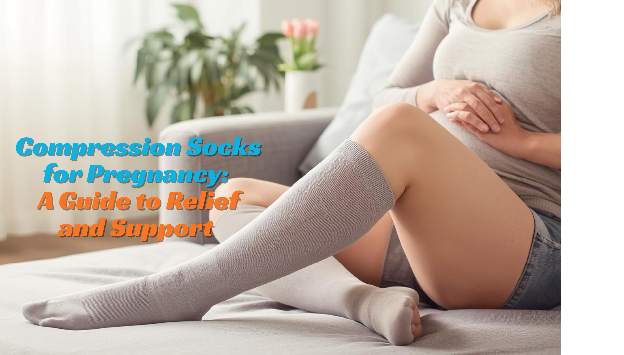
The more useful conversation, and one that rarely happens early enough, is about what compression actually does, when it works best, and how to tell the difference between a sock that will genuinely help and one that will sit in the back of a drawer after two wears.
This is that conversation.
What compression socks actually do during pregnancy
Graduated compression socks apply calibrated external pressure to the lower legs, tightest at the ankle and easing progressively toward the knee.
That directionality is the point: it works with the body's own venous system to push blood upward, back toward the heart, against the increasing gravitational and mechanical resistance that pregnancy creates.
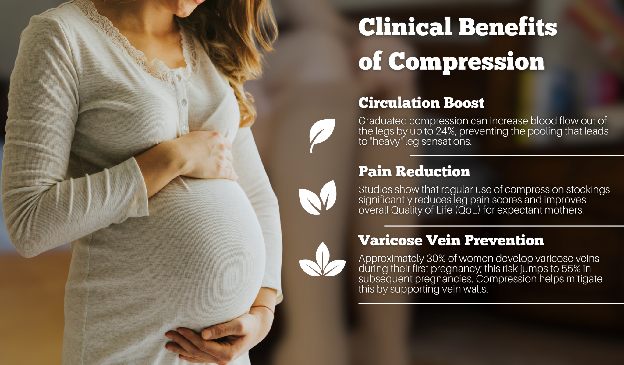 From around the second trimester onward, a growing uterus places mounting pressure on the pelvic veins and the inferior vena cava, the large vessel responsible for returning blood from the lower body.
At the same time, blood volume itself is increasing substantially to support the developing fetus. The result, for many women, is that venous return in the legs becomes sluggish.
Fluid accumulates in the surrounding tissue, producing that familiar heavy-leg feeling and visible swelling in the ankles and feet.
Compression socks address this at the mechanical level. By gently reducing the diameter of the superficial veins in the lower leg, they can support blood flow velocity and reduce pooling that contributes to fluid retention. That’s also why many women find that a true graduated pair, like VIM & VIGR knee-high compression stockings feels noticeably different from a basic “tight sock”: the pressure profile is designed to work with circulation rather than simply squeeze the leg.
They do not eliminate swelling altogether.
Pregnancy edema is a physiological response, not a problem to be solved. But for women who spend long periods on their feet, work desk jobs, or travel during pregnancy, compression can meaningfully reduce how heavy and uncomfortable the legs feel by the end of the day.
The timing question: when should you actually put them on?
This is where the conventional approach tends to fall short. Reaching for compression socks only once swelling has become noticeable is a reactive strategy.
Fluid does not pool all at once; it accumulates gradually throughout the day, compounding with each hour of standing, walking, or sitting with reduced circulation.
The more effective habit is to put compression socks on early, ideally before getting out of bed or within the first 15-20 minutes of the morning, before gravity has had time to begin working against venous return. This preventive approach means the legs are supported from the start of the day rather than playing catch-up by midday.
Think of it less as a remedy and more as a daily support habit, something that works quietly in the background of an ordinary day.
For women on their feet all day, wearing compression throughout the working hours and removing them when elevating the legs at rest tends to offer the most consistent relief.
For desk workers, they are particularly useful during long stretches of sitting when lower-leg circulation tends to be most restricted.
Choosing the right pair: what to look for
Not all compression socks perform the same function, and during pregnancy, the wrong choice can be uncomfortable enough to discourage consistent use altogether. A few practical criteria make the most meaningful difference.
Compression level
For general pregnancy use, a compression grade of 15 to 20 mmHg is commonly associated with everyday comfort and circulatory support. Women experiencing more pronounced swelling, varicose veins, or specific circulatory concerns are generally advised to consult their midwife or OB before selecting a higher grade, such as 20 to 30 mmHg.
As with any wellness decision during pregnancy, a care provider is the best guide to individual suitability.
Sock length
Knee-high is the most practical length for pregnancy use, offering targeted support to the ankle and calf without the complexity of a full-length garment that becomes progressively harder to put on as the belly grows.
The knee-high compression stockings are designed with this daily-use reality in mind, using high-quality, breathable fabrics that maintain their graduated compression through extended wear without the clinical aesthetic that has historically dominated the category.
Fabric and fit
Pregnancy can affect how the body regulates temperature, making breathability a more significant factor than it might otherwise be. Moisture-wicking fabrics that allow airflow will be considerably more comfortable during longer wear than synthetic blends that trap heat.
On fit: calf circumference, not shoe size, is the more reliable guide to effective compression. A sock sized only by shoe size is unlikely to deliver consistent pressure across the lower leg.
Measuring the widest part of the calf and matching it to a brand's sizing guide takes about thirty seconds and can make the difference between a sock that works and one that does not.
Design
This is not a vanity point. A compression sock that feels medical, clinical, or aesthetically out of place with an everyday wardrobe is less likely to be worn consistently. Consistent wear is what produces results. Design and function are, in practice, connected.
Other habits that support compression
Compression socks work best as part of a broader set of small, stackable habits rather than as a standalone intervention.
- Staying well hydrated supports overall circulatory function. * Short walks or brief periods of movement during long periods of sitting can assist lymphatic drainage and venous return and boost your energy levels. * Elevating the feet when resting, particularly in the evenings, gives the lower-leg circulation a mechanical assist in the opposite direction of the day's accumulation.
None of these habits require significant time or disruption to a daily routine. Individually, each has a modest effect.
Together, they tend to produce a more meaningful reduction in end-of-day leg discomfort than any single approach alone.
Physical wellness during pregnancy is, in many ways, about understanding how the body's systems are being asked to work differently and making small, practical adjustments in response.
Compression fits neatly into that framework: low effort, consistently worn, and addressing a genuine physiological need rather than a perceived one.
A note on when to check with a provider
For most healthy pregnancies, graduated compression socks in the 15 to 20 mmHg range are considered a low-risk wellness tool.
However, women with pre-existing circulatory conditions, diabetes, peripheral neuropathy, or skin sensitivities affecting the lower legs should discuss compression use with their midwife or OB before starting.
This is a straightforward conversation and in most cases results in a straightforward answer; the note here is simply that pregnancy is a context in which a care provider's input is always worthwhile before adding anything new to a daily routine.
The bottom line
Compression socks are one of the more practically useful tools for navigating the circulatory demands of pregnancy, and one of the more underused ones, largely because the conversation about them tends to happen too late and with too little guidance on what actually matters when choosing a pair.
Start early. Wear them in the morning before swelling has the chance to build. Choose a pair with proper graduated compression, a breathable fabric, and a fit based on calf measurement.
And do not let the category's clinical history put you off: the options available today have moved a long way from the utilitarian white stockings that most people picture.
Comfortable legs are not a small thing when you are growing a person. They are worth taking seriously.
Add allwomenstalk.com as a preferred source on Google to see more of our trusted coverage when you search.